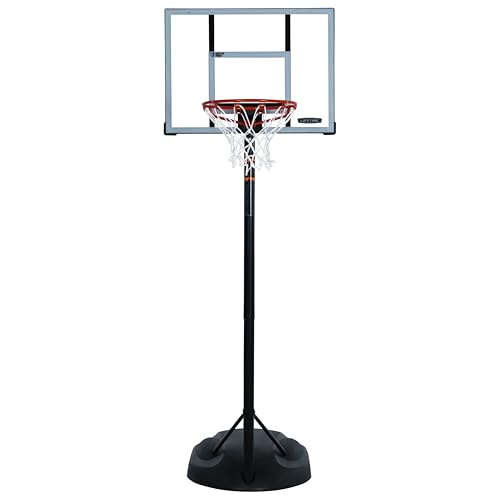
The Lifetime 91115 is a small portable hoop built for younger players: a 30-inch polycarbonate backboard, a 15-inch rim and a telescoping pole that stops at 7.5 ft. It has the lowest reach of any hoop in our lineup, and that is the key fact to understand before buying it. This profile goes through what Lifetime publishes, how the adjustment works, what the setup involves, and where the hoop stops being useful. For the wider field, see our ranking of the best basketball hoops of 2026.
We do not test products. Everything below comes from Lifetime’s product page, its owner’s manual and the NBA and USA Basketball youth guidelines. We leave out prices and ratings because they change often on Amazon.
What Lifetime Says About the 91115
According to Lifetime’s page for model 91115, the highlights are:
- A 30-inch steel-framed polycarbonate backboard, which Lifetime calls virtually unbreakable, with a good rebound.
- A solid-steel Slam-It Jr. rim, 15 inches in diameter, powder-coated, which Lifetime describes as sized for youth basketballs with pro-style breakaway action.
- A telescoping pole that adjusts the rim height from 5.5 to 7.5 ft in 6-inch increments, without tools, according to Lifetime.
- A 2-inch round powder-coated steel pole.
- A youth base that Lifetime describes as lightweight and easy to relocate, and stable and reliable when full, filled with sand or water.
- An all-weather net and fade-resistant graphics, and a 5-year warranty.
Lifetime’s feature list calls it a “10-Gallon Youth Base,” while its specifications table lists a base volume of 9 gallons. Lifetime’s listing is not consistent on this point, so rely on the manual’s weight figure for sand rather than a gallon count.
Specs at a Glance
From Lifetime’s specifications table:
- Backboard: 30 by 21.75 inches.
- Rim: 15-inch diameter.
- Adjustment: 66 to 90 inches, in 6-inch increments.
- Lowest and highest backboard heights: 77.5 and 107.5 inches.
- Assembled size: 50 inches long, 30 inches wide and 107.5 inches tall.
- Pole: 2-inch round steel, in three pieces.
- Base: 31.65 by 23 by 6.17 inches.
- Age class: Youth.
The manual lists a minimum operational height of 5 ft 3 in to the bottom of the backboard, which is a reminder that even the lowest setting is not a toy-box height. The backboard offset is listed as not applicable.
The Height Question
The most important thing about this hoop is the range. The NBA and USA Basketball youth guidelines suggest an 8 ft basket for ages 7 to 8 and a 9 ft basket for ages 9 to 11 in youth competition, when possible, and they explain that lowering the basket for younger players helps them develop proper shooting form and have more success. The 91115 tops out at 7.5 ft, below both of those heights. That makes it a hoop for players who are smaller or younger than the youngest age group in the guidelines, or for casual play at a low rim.
Lifetime publishes no minimum or maximum age for this hoop that we could find. It classes the hoop as Youth and describes it as the right size for kids learning the game. We do not make up an age range, and we do not recommend it for toddlers. Instead, think in terms of rim height. If your child is comfortable at 7.5 ft or lower and you expect that to hold for a year or two, this hoop works. If they are already shooting at 8 ft or 9 ft, they will outgrow it quickly, and the Lifetime 44-inch Impact or Lifetime 52-inch Power Lift, which both reach from 7.5 to 10 ft, will last longer.
How the Adjustment Works
According to Lifetime’s manual, the system can be adjusted from 5.5 ft to 7.5 ft, and only adults should adjust the height. The steps are to stand behind the system and pull on the pole until the backboard rests on the ground, remove the adjustment knob and the carriage bolt, set the system to the desired height, replace the bolt and knob, and make sure the knob is secure before the system is stood back up to playing position. Lifetime’s warning sticker also says to keep hands and fingers away from moving parts when adjusting, and not to allow children to move or adjust the system.
That adult-only rule is worth taking seriously. A child who wants to raise the rim should ask a parent, since the system has to be tipped back until the backboard rests on the ground and the bolt taken out.
Backboard and Rim
A 30-inch board is small. Lifetime’s backboard is 30 by 21.75 inches, a fraction of the 52-by-33-inch board on its Power Lift hoop, so there is less backboard to work with when a shot is off line. For learning form and shooting at a lower rim, that is fine, and the 15-inch Slam-It Jr. rim is sized for youth balls. Lifetime says the rim has breakaway action.
The warning sticker says to hang from the rim only briefly to regain balance or avoid injuring others, and the warranty says hanging from the rim voids it. Our advice is that kids should not hang on the rim at all. The sticker also says players should keep their faces away from the board, rim and net, and should not wear jewelry that could tangle in the net.
Base, Ballast and Safety
The base is where a small hoop can still go wrong. Lifetime’s manual says never to put the system in an upright position without proper weight in the base, because it may fall over and cause serious injury or property damage. The warning sticker says the unit will tip quickly if it is stood up before the base is filled.
- Sand is recommended. The manual’s materials list shows 120 lb. One adult holds the pole while sand is added until it is just below the fill hole, then a second adult raises the system carefully until it is almost upright and the filling is finished. Insert the base plug afterward.
- Water is allowed, with one tablespoon of chlorine bleach added. Lifetime recommends sand because a leak can let water run out unnoticed and the system can fall. Check the base daily for leaks. If you find one, lay the system down and call Lifetime customer service.
- Lifetime recommends at least two or three people for setup, and says children should not move or adjust the system.
- The surface under the base must be smooth and free of gravel or objects that could puncture it.
The sticker also warns against using the system in windy or severe weather, which is worth remembering with a hoop this small and light.
Upkeep and Warranty
Lifetime’s maintenance steps are basic: check hardware, look for wear, check the pole for rust or chipped paint, and make sure the warning sticker is still legible. The sticker advises checking the system before each use for ballast, loose hardware, wear and instability.
According to the manual, the 5-year limited factory warranty runs from the date of original retail purchase and covers defects. Improper installation, alteration and accidents are excluded, and the manual says hanging from the rim and institutional or commercial use void the warranty.
How It Compares With Neighbors
Lifetime’s larger hoops are built for a longer growth curve. The Lifetime 44-inch Impact reaches the standard 10 ft with a manual height change, and the Lifetime 52-inch Power Lift does the same with a one-hand lift. Both need much more ballast than this one. The 91115 is lighter and smaller, and that is its appeal and its limit.
Who It Fits
- Households with younger or smaller players who shoot at a rim below 8 ft.
- Buyers with limited space who want a compact portable hoop.
- Parents who want an adult-adjusted hoop they can move into a corner of the driveway or patio.
Who Should Skip It
- Anyone whose child already plays at 8 ft or 9 ft, or who wants a hoop that adults can use at 10 ft.
- Windy sites, since the base is small.
- Buyers who expect to hand the adjusting job to the kids.
Before you order, work out the rim height your child needs now, pick a sheltered spot with a smooth surface, and plan for an adult to fill the base completely. Read Lifetime’s warnings before the first game.
See the Lifetime Youth 30” Portable on Amazon
Sources