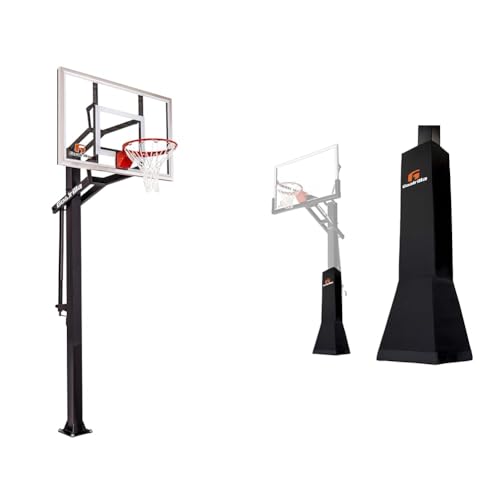
The Goalrilla GS54C is a 54-inch in-ground basketball hoop built around a tempered glass backboard, a one-piece square steel pole and a bolt-down anchor kit. It sits at the compact end of Goalrilla’s GSc line, so it aims at families who want a real glass-board hoop in a permanent spot but do not have a driveway that suits a 60 in or 72 in board. This profile goes through what Goalrilla publishes about the model, what the installation involves, and who is likely to be happy with it. For the full field, see our ranking of the best basketball hoops of 2026.
We do not test products; everything here comes from Goalrilla’s product page, its buying guide and in-ground hoop collection page, and the national 811 site, and where a source does not give a number we say so.
What Goalrilla Says About the GS54C
According to Goalrilla’s product page for the GS54C (SKU B5003W-1), the hoop has these key features:
- A 54 in by 34 in basketball backboard made of tempered glass, 3/8 in thick.
- A welded steel board frame and welded, ultra-wide span arms, which Goalrilla says give a consistent rebound.
- A one-piece 5 in by 5 in pole and a maximum overhang of 2.5 ft.
- Adjustable height, with an in-ground design backed by a Goalrilla limited lifetime warranty that includes the glass.
- Powder-coated steel, which Goalrilla says protects against rust and UV.
- A medium-weight breakaway rim and a 9 in basketball hoop anchor kit listed as included accessories.
Goalrilla’s buying guide adds that the GSc series uses a proven design shared with its flagship DC72E1, with unobstructed visibility and an adjustable height actuator. It describes the GS54c as “a compact 54 in option ideal for smaller driveways or tighter court spaces.”
One detail specific to Amazon: the listing we link to is sold as a bundle that adds a Goalrilla weatherproof pole pad to the hoop. Goalrilla’s own page for the GS54C does not list a pole pad as an included accessory, so the pad is part of the Amazon bundle, not something every GS54C purchase includes. Look at the listing’s contents before you order.
The Backboard and Overhang
Tempered glass is the headline. Goalrilla’s buying guide says tempered glass is the same material used in gymnasiums at the high school, college and professional levels, and that it gives the best rebound performance of the backboard types it covers. It also says that if tempered glass breaks, it crumbles in place much like a car windshield rather than falling in large shards. That is Goalrilla’s description of the material in general, not a rating for this specific board.
The GS54C board measures 54 in by 34 in. Goalrilla’s guide says NCAA and NBA regulation backboards are 72 in wide by 42 in tall, so this is a step down from full size. The guide suggests a one-car driveway may be better paired with a 54 in backboard, while a two- to three-car driveway may suit 60 to 72 in. If you mostly shoot jumpers, practice layups and play pickup games with a few people, the smaller board works. If you or your kid are working toward a competitive level, a bigger board is closer to what you will see in a gym.
Overhang is the distance from the pole to the backboard, and it matters more than most buyers expect. Goalrilla’s guide says to look for roughly 2 to 4 ft for a good balance, because too much overhang takes court space and adds shake. Goalrilla lists the GS54C at a maximum of 2.5 ft, and it points to an overhang chart so you or your installer can pick a spot for your specific model. Because overhang changes as you adjust the height, plan the pole position with the whole 7.5 to 10 ft range in mind.
Height Adjustment
According to Goalrilla’s buying guide, its adjustable goals run from 7.5 ft to 10 ft. That range lets younger players shoot at a lower rim and the household move up to regulation height later. Goalrilla’s guide puts the NCAA and NBA regulation height at 10 ft and gives a table of heights by age. If you are setting up for school-age kids, the NBA and USA Basketball youth guidelines are a useful companion read when you decide where to set the rim for a given age.
Goalrilla’s page describes the GS54C as height-adjustable but does not spell out the adjustment mechanism, so check the owner’s manual for how it works and whether it takes one person or two.
Installation, Anchoring and Moving
This is the part that separates an in-ground hoop from the portable models on our site. Goalrilla says the GS54C’s in-ground anchor is secured directly in concrete, and that while the installation is permanent, the bolt-down design lets you disconnect the hoop if you move. The guide says that when in-ground hoops are installed with an anchor kit you can unbolt and relocate the hoop, though at the new house you would need to buy and install another anchor kit.
Goalrilla’s buying guide says the whole process generally takes about four days, including roughly three days for the concrete to set and cure and one day to assemble the hoop. It adds that some consumers do it themselves, but many homeowners choose a professional installer. We think that is the right call for most buyers: this is heavy, permanent work, so we suggest considering professional installation and following Goalrilla’s installation guide and the manual shipped with the hoop. We are not going to give a step-by-step here.
Two practical reminders from the sources:
- Call 811 before you dig. The 811 site says to contact 811 or your state 811 center a few business days before any digging so buried utility lines can be marked, and Goalrilla’s own guide says to call 811 before you dig to mark gas or electrical lines.
- Check local rules. Goalrilla’s guide says to check with your homeowner’s association and local laws, since some neighborhoods restrict goals near the street or in the driveway, and it says not to place a hoop in or overhanging the street.
For playing room, Goalrilla recommends at least 10 ft of concrete in front of the goal and preferably closer to 15 ft, the distance of the free throw line.
Rim, Pole and Finish
The rim is the part that takes the most punishment. Goalrilla says standard rims are 18 in across and that breakaway rims, used in college and the pros, flex under pressure and move the shock of a dunk to the pole rather than the backboard. The GS54C is listed with a medium-weight breakaway rim.
On the pole, the GS54C uses a one-piece 5 in by 5 in design. Goalrilla’s guide says a square pole offers the most rigidity and that most single-piece poles are 4, 5 or 6 in square. A powder-coated finish, which the page lists for this hoop, is less likely to rust than paint, according to Goalrilla.
Warranty
Goalrilla’s page says the GS54C is covered by a Goalrilla limited lifetime warranty that includes the glass. We could not open the warranty terms, so read the full text and register the product before you rely on it, and note that what the Amazon bundle adds, such as the pole pad, may carry its own terms.
How It Compares With Its Neighbors
Within Goalrilla’s own line, the GS54C is the smallest of the GSc series. The GS60C steps up to a 60 in by 36 in board on a 5.5 in square pole, and the GS72C to a 72 in by 40 in board on a 6 in pole with a 3 ft overhang, according to Goalrilla’s comparison table. The GS54C is the one to pick when a smaller board and a shorter overhang suit your space.
If a portable system is on your list, Goalrilla’s buying guide says portable hoops use lighter plastic backboards and cannot endure heavy play such as dunking because of the tipping risk, which is a real trade-off against an in-ground hoop. If you want a glass board without concrete, our Spalding The Beast 60” profile covers a big portable option.
Who Should Buy It
- Families with a one- or two-car driveway where a 54 in glass board fits the space.
- Buyers who want a permanent hoop with an adjustable 7.5 to 10 ft range for kids who will grow into it.
- Owners who may move one day and like the idea of unbolting the hoop.
- Households ready to pay for or arrange a proper concrete install.
Who Should Skip It
- Renters, or anyone who cannot dig and pour concrete at their address.
- Players who want a full-size 72 in board or a heavier-duty rim and are comfortable with a larger system.
- Buyers who want to move the hoop around the yard or store it for winter, since a portable hoop fits that better.
- Anyone who has not checked for buried utilities or HOA limits yet.
Measure the spot, mark where the pole and overhang will fall at both 7.5 ft and 10 ft, call 811, and keep the manufacturer’s manual and installation guide as your instructions.
See the Goalrilla GS54C on Amazon
Sources