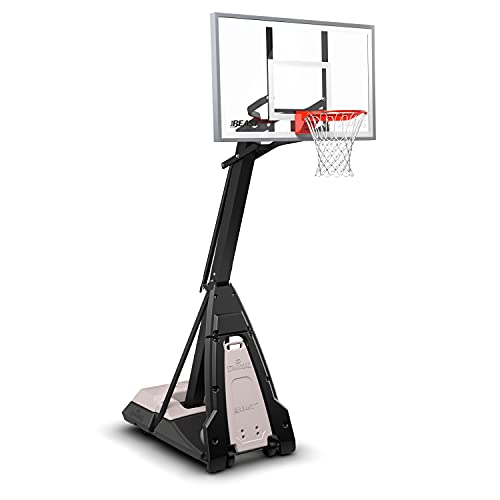
The Spalding Beast is the brand’s flagship portable basketball system: a tempered glass backboard, a thick square steel pole and a wheeled base that you fill with water or sand instead of pouring concrete. This profile looks at the 60-inch version sold on Amazon, what Spalding publishes about it, the compromises that come with any portable hoop, and who is likely to be happy with it. For the wider field, see our ranking of the best basketball hoops of 2026.
We do not test products. This profile is based on Spalding’s own product page, and where the page describes the whole Beast line instead of the 60 in size, we say so and keep the numbers as ranges.
What Spalding Says About The Beast
Spalding’s product page describes The Beast as “a professional-grade portable basketball system designed for players who want in-ground-level performance with long-term stability at home.” It says the hoop is “the only portable system of its size.” Treat that as marketing language, but it tells you where Spalding positions it: at the top of its portable range, aimed at driveway use with a full-size board.
The features list on Spalding’s page covers the whole Beast line, not just the 60 in model:
- Backboard sizes of 72, 60 and 54 in.
- A tempered glass or performance acrylic board.
- A steel board frame with aluminum trim.
- Arena Slam and Steel Pro Image breakaway rims available.
- 7.5 to 10 ft height adjustment with a screw jack lift.
- A 4 in or 5 in Apex Angle square steel pole.
- A Power Move base that fills with 40 or 55 gallons of water or sand.
- Wheels, with listed base dimensions of 62.9 in by 36 in by 14 in.
Because the page lists these as options and ranges across three sizes, we cannot tell you from Spalding’s page whether the 60 in model has the 4 in or 5 in pole, or the 40 or 55 gallon base. The Amazon listing for this ASIN is titled as the 60 in tempered glass model. For the exact pole, rim and base capacity, check the manual that ships with the hoop (Spalding offers an interactive manual on its product page).
Backboard: Glass at 60 Inches
The Amazon listing is titled as the tempered glass version, which is the board type most buyers choose a Beast for. Goalrilla’s buying guide, from a competing brand, says tempered glass is the material used in gymnasiums at the high school, college and professional levels, and that it gives the best rebound of the common backboard types. Goalrilla also says NCAA and NBA regulation backboards are 72 in wide by 42 in tall, so a 60 in board is a step below full regulation size but larger than the 44 to 54 in boards on many portable hoops.
Spalding’s page does not give the 60 in board’s height or thickness, and we are not going to guess. If you care about those dimensions, look at the manual or Spalding’s support team before you order.
Height Adjustment: The Screw Jack Lift
Spalding says The Beast has infinite adjustability from 7.5 ft to 10 ft with a screw jack lift, and describes the hoop as easy enough for anybody to use. Infinite adjustment means you can stop the rim anywhere in that range. For families, that is the main reason to buy an adjustable hoop: you can set a lower rim for younger players and move up to regulation 10 ft as they grow.
For school-age kids, the NBA and USA Basketball youth guidelines suggest an 8 ft basket for ages 7 to 8 and a 9 ft basket for ages 9 to 11, when possible, and an adjustable system lets you follow them. Adults should handle every height change, following the manual’s steps.
The Power Move Base and Mobility
The base is the defining part of any portable hoop. Spalding says the Power Move base fills with 40 or 55 gallons of water or sand, and that portable systems are designed for stability on flat surfaces, with the base keeping the hoop in place without concrete. Spalding describes an integrated 4-wheel base that allows mobility without tilting the hoop forward, and the page lists base dimensions of 62.9 in by 36 in by 14 in.
A few practical points follow from that:
- Fill the base completely, as the manual directs, before you play. A portable hoop is held in place by the weight in its base, so an under-filled base is the main way these systems tip.
- Water and sand are both options, per Spalding. Check the manual for which it recommends and how to fill and empty the base.
- Wheels make repositioning possible, not casual. A fully filled system is heavy, so adults should do any moving or adjusting, and the base should be placed on a flat, level surface.
- If you live where winters are cold, read the manual for what it says about leaving water in the base.
Goalrilla’s buying guide says portable hoops cannot endure heavy or rough play such as dunking because of the risk of tipping or falling over, and that their lifespan is roughly 2 to 5 years, with the blow-molded base typically the first part to fail. That is a competitor’s general claim about portable hoops, not a statement about The Beast, so weigh it as such. It is still a reasonable reminder to treat any portable base as the part to inspect first.
Rim and Net
Spalding’s page lists Arena Slam and Steel Pro Image breakaway rims as available in the line. It does not say which rim comes with the 60 in model on Amazon, so confirm that in the listing. A breakaway rim flexes under load, and Goalrilla’s guide says that is what lets the rim take a dunk instead of passing the shock to the backboard. Whatever rim you have, we do not recommend hanging on it, and adults should supervise younger players.
Portable or In-Ground?
The Beast is built to answer one question: can you get a glass-board hoop without digging and pouring concrete? Spalding says yes, and that the hoop gives “the stability and reliability of an in-ground hoop.” Other makers disagree on how close any portable gets. Goalrilla says an in-ground hoop’s concrete installation removes the risk of tipping, especially during a dunk, and that in-ground goals take up less ground space than a portable’s molded base.
If you will play physically, dunk, or play pickup games every weekend, that argument is worth hearing out. If you rent, may move, want to bring the hoop in for winter or cannot dig in your yard, a portable like The Beast is the practical way to get a big board. If you do consider an in-ground hoop, call 811 before any digging, as the national 811 service advises, and consider professional installation.
For a bolt-down in-ground alternative, see our Goalrilla GS54C profile. It has a smaller 54 in glass board but is a permanent install.
Warranty and Support
We could not find a warranty description on the Spalding page we opened, so we are not going to quote a term. Spalding’s page does list support tools such as a manual finder, a parts finder and a warranty claim form. Register the hoop, save your proof of purchase and read the warranty before you rely on it.
Who Should Buy It
- Families who want a full-size glass board and 10 ft regulation height without a permanent install.
- Households that need an adjustable rim for several ages and a hoop that can be repositioned on the driveway.
- Renters and anyone who may move, since there is nothing to pour or unbolt.
- Buyers who are comfortable with a big, heavy system and a base that needs filling.
Who Should Skip It
- Players who dunk or play rough every day and want the most rigid setup, who may prefer an in-ground hoop.
- Buyers who want a small, light hoop that one person can move with ease.
- Anyone who needs exact specs for the 60 in model in advance, since Spalding’s page lists line-wide ranges for pole and base.
- Households with no space for a roughly 63 in long base footprint, which Spalding’s listed base dimensions imply.
Before you order, measure the spot, confirm the board type and rim in the Amazon listing, and plan where the fill material will come from. Keep the manual and follow it for filling, setup and use.
See The Beast 60” on Amazon
Sources