We earn a commission if you buy through our links, at no extra cost to you.
Best Basketball Hoops for Adults: Driveway Picks
Choosing a driveway or backyard basketball hoop for adults and teens: 10 ft regulation height, glass vs acrylic vs polycarbonate, in-ground vs portable, 811 checks.
At a glance
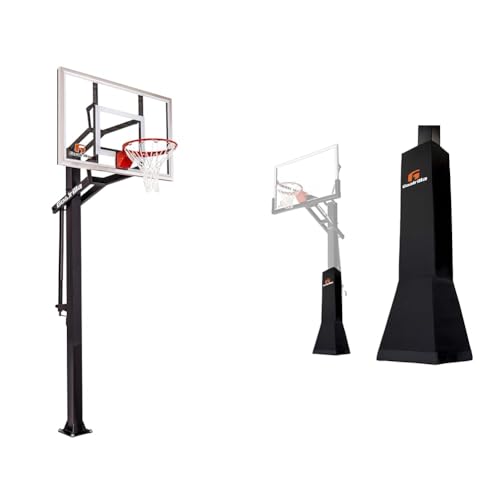
For adults who want a permanent glass-board hoop, Goalrilla GS54C is the in-ground pick. Spalding The Beast 60" gives a glass board without concrete, and Lifetime Mammoth Lift Bolt Down 54" adds a lever-adjust glass board. Set the rim at the regulation 10 ft.
An adult-sized hoop is a different purchase from a kid’s one. You want the regulation 10 ft rim, a backboard that gives a true bounce, a pole that does not rock when you drive and a rim that survives hard play. You also need a spot for it, and in many neighborhoods a permit or a call to the homeowners association. This guide walks through the choices that matter for adults and teens playing in a driveway or backyard, then points to the models from our basketball hoop ranking that fit.
We do not test products. The numbers below come from the manufacturers’ pages and manuals, the Goalrilla and Spalding buying guides and the national 811 site. Both guides come from hoop makers, so we say whose claim is whose.
Start With the Regulation Height
Goalrilla’s buying guide says 10 ft is the official hoop height for high school, college and professional play, from age 12 up. Every adjustable model we recommend here covers 7.5 to 10 ft, which matters even for an all-adult household: the same range lets younger family members use the hoop. For kids specifically, see our kids’ hoop guide.
Glass, Acrylic or Polycarbonate
Backboard material changes how the ball comes off the board and how much the hoop weighs. Spalding’s buying guide rates tempered glass as its top material, in sizes from 54 to 72 inches, with the best rebound. Acrylic comes next, in sizes from 50 to 72 inches, with a better rebound than the lower tiers. Polycarbonate, in sizes from 42 to 54 inches, is described as suited to casual play, with a good rebound.
Goalrilla’s guide adds that tempered glass is the material used in high school, college and professional gyms. It also says that if tempered glass breaks it behaves like a car windshield, holding the pieces in place. Regulation NCAA and NBA backboards are 72 inches wide by 42 inches tall, so a 54 in or 60 in board is a smaller version of the real thing.
In short: choose glass if rebound and look matter most, and choose polycarbonate if you want a lighter, less expensive board for casual shooting. Check the warranty too. Goalrilla says its limited lifetime warranty covers the glass, while Lifetime’s manual says its warranty does not cover breakage of the tempered glass.
In-Ground or Portable
An in-ground hoop is set in concrete. Goalrilla’s guide says the concrete installation makes the hoop much more stable and removes the risk of tipping, especially during a dunk, and that in-ground hoops take up less ground space than a portable’s molded base. A portable hoop sits on a base you fill with water or sand. Spalding says its portable systems are designed for stability on flat surfaces and need no concrete.
Goalrilla, which sells in-ground hoops, also says portable hoops generally use lighter plastic backboards, last roughly 2 to 5 years on average and cannot endure rough play. Spalding’s Beast is a counterexample on the board, since its page lists a tempered glass option for a portable system. Weigh the claim accordingly, but the tipping point stands: a portable hoop is held down by what is in the base, so fill it completely, as the manual directs, before anyone plays.
Within in-ground hoops there are two anchoring styles. A bolt-down anchor sets a plate in concrete and the pole bolts to it, so you can unbolt the hoop if you move. This is how Goalrilla describes the GS54C and how Lifetime describes its Mammoth Lift. The Silverback NXT in-ground instead sets the pole in the ground with concrete poured inside it, so it stays with the house.
Overhang and Court Space
Overhang is the distance from the pole to the face of the backboard. Goalrilla says to look for roughly 2 to 4 ft: enough that players can cut under the basket without hitting the pole, but not so much that the board shakes. It says an overhang of 5 ft or more can add shake. Goalrilla lists a maximum overhang of 2.5 ft for the GS54C and for the Silverback NXT 54 portable.
Also plan for space in front. Goalrilla recommends at least 10 ft of concrete, preferably about 15 ft, which is the free throw distance. It says not to place a hoop in or overhanging the street.
Before You Dig: 811, Power Lines and Local Rules
Three checks come before any in-ground purchase. First, call 811. The national 811 service says to contact it or your state 811 center a few business days before any digging, and to wait for the utilities to mark their buried lines before you break ground. Second, look up. Lifetime’s manual for the Mammoth Lift says to make sure there are no overhead power lines within a 20 ft radius of the pole location. Third, ask your homeowners association and check local rules, since Goalrilla notes that some neighborhoods prohibit goals near the street or in the driveway.
Lifetime’s manual also says the concrete must cure for at least 72 hours, or three days, before the backboard goes on, and Goalrilla’s guide describes about four days overall. We do not give installation steps here. Consider professional installation, and follow the manual that comes with the hoop.
Goalrilla GS54C: Permanent Glass in a Driveway Footprint
A 54 x 34 in tempered glass board on a one-piece 5 x 5 in pole with a bolt-down anchor, for a one- or two-car driveway.
According to Goalrilla, the GS54C has a 3/8 in tempered glass backboard on a welded steel frame, a one-piece pole and a maximum overhang of 2.5 ft, with height adjustment from 7.5 to 10 ft. The warranty is a limited lifetime one that includes the glass. The Amazon listing bundles the hoop with a Goalrilla pole pad. It suits adults who want a permanent hoop and a 54 in board that does not overwhelm the driveway. The Goalrilla GS54C profile has the details.
Lifetime Mammoth Lift Bolt Down 54: Lever Adjustment on Glass
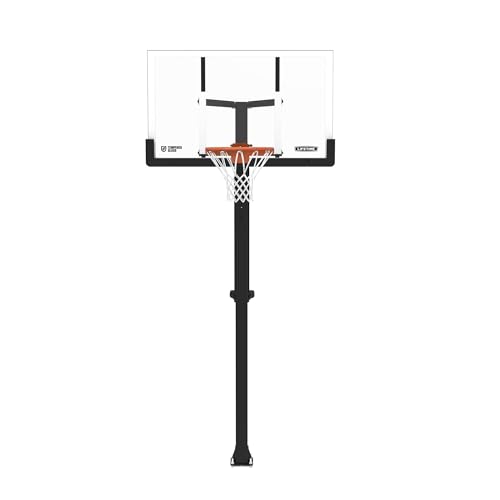
A 54 in glass board with a squeeze-lever lift from 7.5 to 10 ft and a bolt-down anchor you can take with you.
Lifetime says the 3/8 in glass is fused to a heavy-duty steel frame and that the Mammoth Lift lets you squeeze a lever and glide the rim anywhere from 7.5 to 10 ft. The pole is a two-piece 4 in square steel pole. The manual covers the 811 call, the 20 ft power-line rule and the 72-hour cure. See the Lifetime Mammoth Lift profile.
Silverback NXT 60 In-Ground: A Wider Board Without Glass
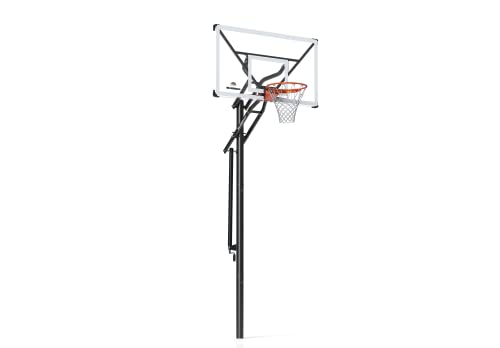
A 60 x 34 in board with a crank lift and breakaway rim, for adults who plan to stay put and prefer a polycarbonate board.
Silverback is Goalrilla’s sister brand. The NXT 60 has a 60 x 34 in board with folded edges, an all-steel crank from 7.5 to 10 ft and a spring-activated breakaway rim. Goalrilla says it arrives partly assembled and can be put together in 90 minutes or less, and lists a 5-year limited warranty. Check its manual for concrete curing time, since the product page does not say. More detail is in our Silverback NXT 60 profile.
Spalding The Beast 60: Glass Without Concrete
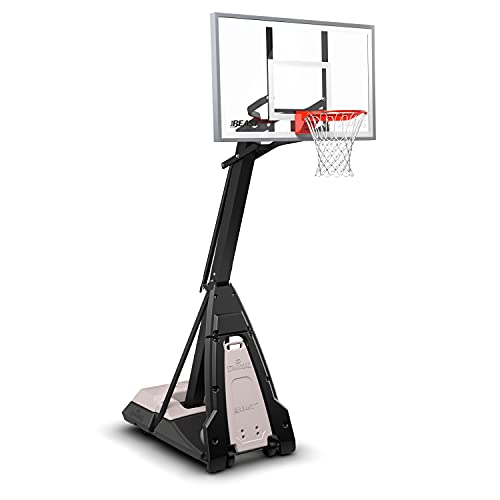
A tempered glass board and screw jack lift on a wheeled, fillable base, for adults who cannot or do not want to pour concrete.
Spalding says The Beast offers infinite adjustment from 7.5 to 10 ft with a screw jack lift and an integrated 4-wheel base. Its page describes the line as having a 4 or 5 in pole and a base that fills with 40 or 55 gallons of water or sand, so confirm the figures for the 60 in size in the manual. It is the answer for renters and for yards where digging is not allowed. See the Spalding The Beast profile.
Silverback NXT 54 Portable: Roll It Aside
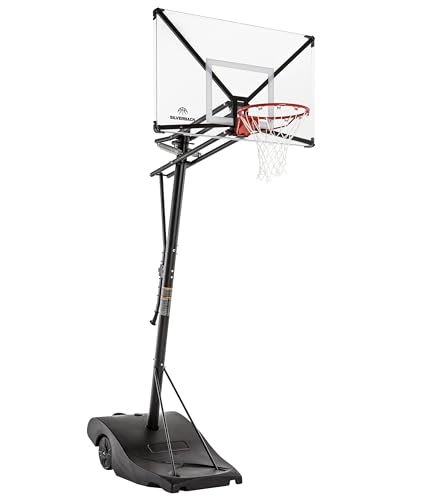
A steel-chassis portable with a 54 in board, 2.5 ft overhang and 7.5 to 10 ft range, for adults who shoot more than they dunk.
Goalrilla describes a steel-on-steel Stabili-Frame connection and an ErgoMove wheelbarrow design that two people tilt and roll, with a kickstand at the rear. Assembly takes about 90 minutes according to the maker. Because it is portable, keep to Goalrilla’s own caution about rough play. The Silverback NXT 54 profile explains which version the listing is.
Which Type Fits Which Adult
- Own the home, plan to stay, want a real feel: the Goalrilla GS54C or Lifetime Mammoth Lift for glass, or the Silverback NXT 60 for a wide board without glass.
- Rent or may move: The Beast or the Silverback NXT 54 portable, filled completely and kept on a flat, hard surface.
- Dunk often: favor an in-ground model with a breakaway rim, per Goalrilla’s guide. Even then, Lifetime’s manual allows hanging from the rim only briefly to regain balance.
Pick the type first, then the board, and keep the 811 call, the overhead line check and the HOA question ahead of the checkout button.
Sources
- Goalrilla basketball hoop buying guide
- Spalding basketball hoops buying guide
- 811 Before You Dig (call811.com)
- Goalrilla GS54C official product page
- Lifetime Mammoth Lift Bolt Down 54-inch (model 91198) official product page
- Lifetime Mammoth Lift Bolt Down (91198) owner’s manual (PDF)
- Silverback NXT 60 In-Ground official product page on goalrilla.com
- Silverback NXT 54 Portable official product page on goalrilla.com
- Spalding The Beast portable basketball hoop official product page
Frequently asked questions
What height should a basketball hoop be for adults?
Ten feet. Goalrilla's buying guide calls 10 ft the official height for high school, college and professional play, for ages 12 and up. Every hoop in this guide adjusts from 7.5 to 10 ft, so you can lower it for younger players.
Is a glass backboard worth it for a driveway hoop?
Glass gives the truest rebound, according to both Goalrilla and Spalding, but it is the heaviest and usually the most expensive option. If you mostly shoot around, a polycarbonate board such as the Silverback NXT 60 in-ground is a sensible step down.
Can I dunk on a portable hoop?
Goalrilla's buying guide says portable hoops cannot endure heavy or rough play such as dunking because of the risk of tipping. Lifetime's manual says to hang from the rim only briefly to regain balance. If you plan to dunk, look at an in-ground hoop with a breakaway rim.
Do I need to call 811 before installing an in-ground hoop?
Yes. The 811 service says to contact 811 or your state 811 center a few business days before any digging, then wait for the utilities to mark their lines. Lifetime's manual also says there should be no overhead power lines within a 20 ft radius of the pole location.
Should I hire an installer?
Goalrilla says some homeowners handle an in-ground install themselves but many hire a professional, and its guide describes about four days including concrete curing. Consider professional installation, especially near utilities.
How much driveway space does a hoop need?
Goalrilla recommends at least 10 ft of concrete in front of the goal, preferably about 15 ft, the distance of the free throw line. It suggests a 54 in board for a one-car driveway and a 60 to 72 in board for two or three cars.